

We are living through a period marked by the resurgence and normalization of armed conflict, leaving in its wake widespread civilian suffering, mass casualties, and grave human rights violations. In such times, attention to how societies acknowledge harm, restore dignity, and support survivors, their families, and affected communities is more relevant than ever. Examining effective and innovative reparations programs is therefore essential, not only to learn from past practice, but to strengthen approaches that place human rights, dignity, and the protection of those affected by conflict at the centre of efforts to build a more just and peaceful world.
March 1, 2026, marks five years since Iraq’s parliament passed the Yazidi [Female] Survivors Law (YSL), establishing an administrative reparation program. The law represents a pivotal step in Iraq’s efforts to address the legacy of violence committed by the self-declared Islamic State in Iraq and the Levant (ISIL) and provides access to a variety of rights and benefits for Yazidi, Turkmen, Christian, and Shabak women and girls victims of conflict-related sexual violence (CRSV), including victims of kidnapping, sexual enslavement, forced marriage, pregnancy, and forced abortion; for Yazidi, Christian, Shabak, and Turkmen survivors of mass killing operations carried out by ISIL; and for Yazidi children kidnapped by ISIL.
The YSL mandates a number of critical reparations, including monthly compensation payments; medical and psychological care; the provision of land and housing; educational opportunities; and a quota in public sector employment. It also officially recognizes that ISIL committed genocide and crimes against humanity, mandates memorialization, the search for those still in captivity, the exhumation of mass graves–along with the identification and return of remains to families–and calls on Iraqi institutions to ensure that perpetrators of genocide and crimes against humanity are held accountable. The associated bylaws further extend these obligations, including developing specialized curricula on the ISIL conflict to promote peaceful coexistence and renunciation of violence. Finally, the YSL explicitly stipulates an objective to, inter alia, prevent the recurrence of the violations that occurred against the indicated minorities.
Over the past five years, Iraq has made significant progress in facilitating access to compensation under the YSL. Notably, the regular provision of monthly payments—reaching at least 2,216 survivors as of January 2026—constitutes important recognition of harm and has produced tangible improvements in survivors’ daily lives. A recent survey conducted by the Coalition for Just Reparations (C4JR) found that 72% of respondents stated that YSL compensation payments had helped them feel more integrated into society, while 79% indicated that compensation positively affected how they are treated by their family and wider community. These findings demonstrate that reparation payments have had meaningful impacts on survivors’ lives, including enhanced financial stability, increased decision-making power within households, and a strengthened sense of social recognition and dignity.
However, systemic gaps and barriers hinder full access to key reparative services, justice, and accountability. The extra-legal requirement to initiate a criminal investigation, heightened evidentiary standards, and lack of reasoned, dated written decisions continue to inhibit the application, review, and appeal process.
Five years after enactment, Iraq has yet to establish a state-sponsored holistic rehabilitation system for ISIL survivors. Education measures are not trauma-responsive and remain general rather than tailored to the specific needs of survivors. To date, survivors have only been able to exercise their land and housing rights under the YSL in their area of origin, despite ongoing security concerns and inadequate livelihood prospects in those areas, rendering return unviable for a dignified life.
Furthermore, Iraq has yet to enact legislation to incorporate genocide, crimes against humanity, and war crimes into its national law, which impedes efforts to end impunity for ISIL-committed atrocities in the country, leaving survivors without effective avenues to claim justice. This is especially concerning given the recent developments in Syria with the closure of camps and prisons with ISIL detainees, and the transfer of thousands of ISIL members to Iraq to be investigated under the existing anti-terrorism law.
While further efforts are required to fully realize the rights enshrined in the YSL, its adoption and implementation by state authorities—coupled with the advocacy, monitoring, and reporting efforts of survivor associations, civil society, and international organizations—offer a valuable model for advancing survivor-centered approaches in other contexts.
The undersigned organizations, therefore, call.
On the Iraqi government to:
- Ensure fair and transparent YSL application, review, and appeals processes, without imposing time limits or other barriers that may restrict future access to the application procedure;
- Deliver all reparative measures guaranteed under the YSL—including but not limited to compensation, rehabilitation, trauma-responsive education, land, and housing—in partnership with survivors and affected communities;
- Adopt legislation on core international crimes and prosecute ISIL members accordingly, ensuring all proceedings are survivor-centered and compliant with international human rights standards.
- Ensure the issuance of clear and transparent guidelines by the General Directorate for Survivors Affairs, governing application, review, and appeal procedures, as well as standards of proof, in line with the guarantees established under other Iraqi legislation.
On the international community to:
- Establish a UN-managed repository capable of preserving the integral evidentiary holdings of ISIL crimes collected by the UN Investigative Team to Promote Accountability for Crimes Committed by Daesh (UNITAD) as active archives, thus sharing them for prosecutorial purposes upon request, as recommended by the UN Secretary-General.
- Provide technical support and transfer of know-how to Iraqi counterparts to ensure the effective and survivor-centred delivery of vital reparative measures, including but not limited to high-quality rehabilitation services encompassing specialized educational support.
The latest C4JR More than “Ink on Paper” report assessing progress and remaining challenges with detailed recommendations five years after the YSL’s adoption is available here.
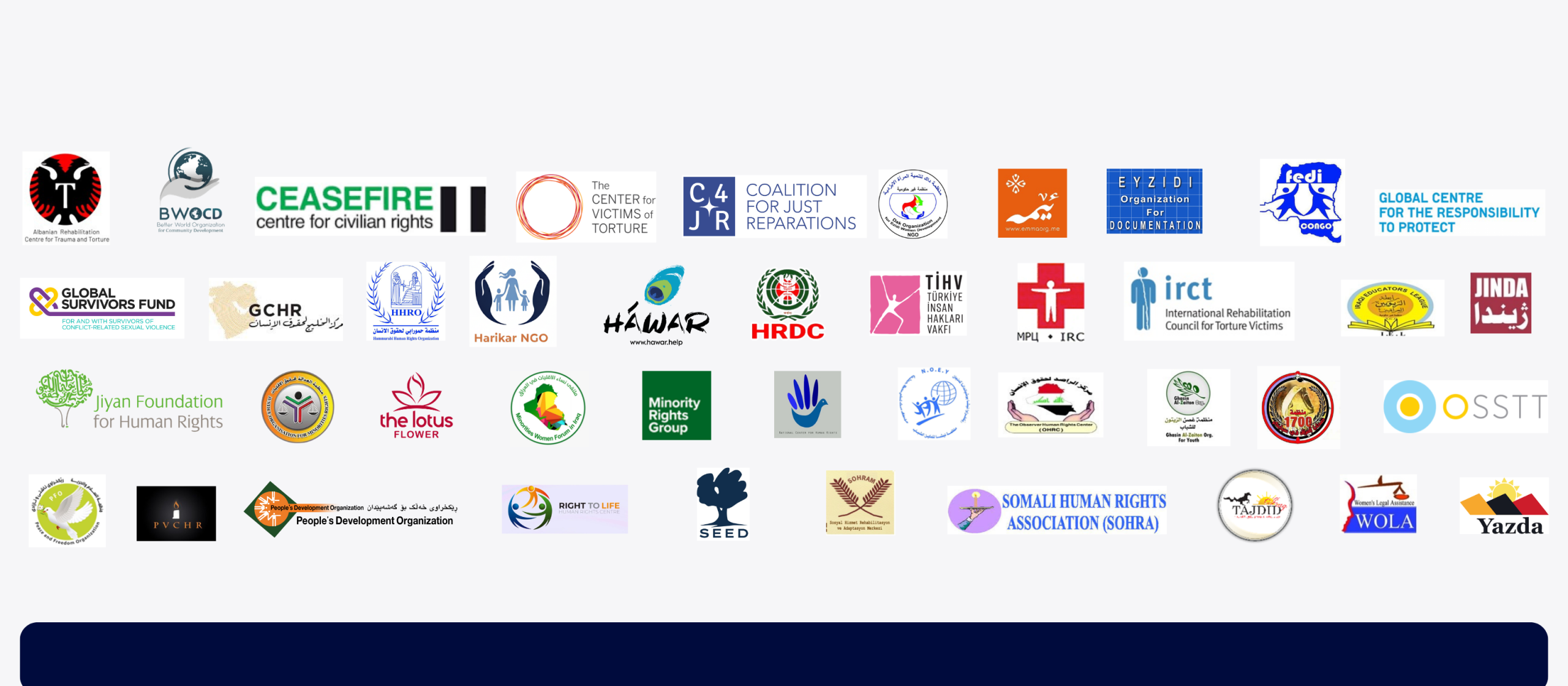
Signatories listed in alphabetical order:
1. Albanian Rehabilitation Centre for Trauma and Torture (ARCT), Albania
2. Better World Organization for Community Development (BWOCD), Iraq
3. Ceasefire Centre for Civilian Rights, United Kingdom
4. Center for Victims of Torture, United States
5. Coalition for Just Reparations (C4JR), Iraq
6. Dak Organization for Ezidi Women Development, Iraq
7. Emma Organization for Human Development, Iraq
8. Eyzidi Organization for Documentation (EOD), Iraq
9.Fédération des Femmes pour le Développement intégral au Congo (FEDICONGO/Uvira), Congo
10. Global Centre for the Responsibility to Protect (GCR2P), United States
11. Global Survivors Fund, Switzerland
12. Gulf Centre for Human Rights (GCHR), Lebanon
13. Hammurabi organization for human rights, Iraq
14. Harikar NGO, Iraq
15. Hawar.Help | International organization, Iraq, Germany
16. Human Rights Development Centre (HRDC), Bangladesh
17. Human Rights Foundation of Turkey (HRFT), Türkiye
18. International Medical Rehabilitation Centre for Victims of Wars and Totalitarian Regimes (IRC), Ukraine
19. International Rehabilitation Council for Torture Victims (IRCT), Denmark
20. Iraqi Educators League, Iraq
21. JINDA Organization
22. Jiyan Foundation for Human Rights, Iraq, Syria, Germany
23. Justice organization for minority rights, Iraq
24. Lotus Flower, Iraq
25. Minorities Women’s Forum in Iraq, Iraq
26. Minority Rights Group International, United Kingdom
27. National Center for Human Rights, Iraq
28. Nisha Youth Empowerment Organization, Iraq
29. Observer Human Rights Center (OHRC), Iraq
30. Olive Branch Organization, Iraq
31. Organization of the Victims of Iraq in Spyker 1700, Iraq
32. Overseas Services to Survivors to Torture and Trauma (OSSTT), Australia
33. Peace and Freedom Organization, Iraq
34. People’s Vigilance Committee on Human Rights (PVCHR), India,
35. People’s Development Organization, Iraq
36. Right to Life Human Rights Center, Sri Lanka
37. SEED, Iraq
38.SOHRAM- CASRA Centre d’Action Sociale, Réhabilitation et Adaptation pour la Victime de la Torture, de la guerre et de la Violence, Türkiye
39. Somali Human Rights Association (SOHRA), Somalia
40. Tajdid Iraq Foundation, Iraq
41. Women Legal Assistance Organization (WOLA), Iraq
42. Yazda, Iraq
Download the Statement (PDF)
Download the joint statement in English or Arabic.